Wright-Austin Exhaust Heads
Steam vent exhaust heads remove droplets larger than 10 microns
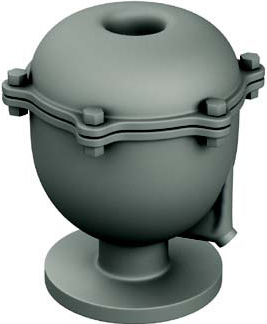
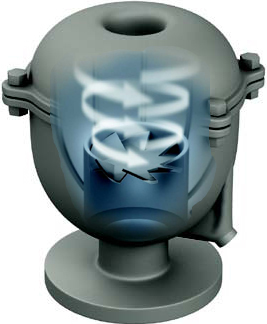
Wright-Austin exhaust heads are installed at the end of pipelines to remove droplets and particulates before they are exhausted into the atmosphere. A common application is at the end of steam vents to reduce the visible condensate plume.
In freezing climates, exhaust heads reduce the hazard of ice accumulation on roofs. Many customers also recover expensive boiler treatment chemicals that would otherwise be carried away with the water droplets. There can also be environmental benefits by reducing discharge onto surrounding properties. View our article on exhaust head designs and applications.
Wright-Austin exhaust heads provide an inexpensive, non-mechanical method of removing 99% of all entrained moisture and particulates >10 microns. No maintenance is required. Recovered liquid can be plumbed for reclamation or sent to drain.
Note: ASME Code Stamps and CRN are not applicable to exhaust heads because one end is open to atmosphere — they are not pressure vessels.
Cast Iron Exhaust Heads
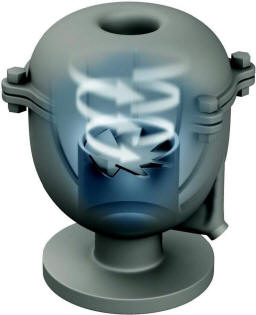
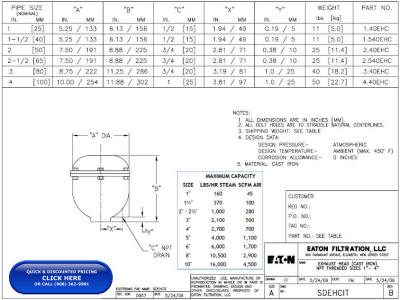
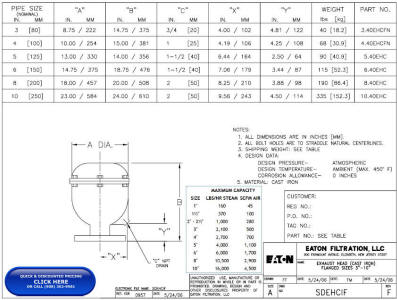
Cast iron exhaust heads are designed for long service life. The body, cover and separating element are high-tensile cast iron that resists fracture and corrosion. They remove droplets as fine as 10 microns with 99% efficiency and are typically used on rooftop steam vent lines.
Although an exhaust head has a mild muffler-like effect, its purpose is liquid separation — not noise reduction. Components are usually stocked and shipments can often be made within one week.
Cast Iron Exhaust Head Drawings (includes maximum capacity by size)
Fabricated Exhaust Heads
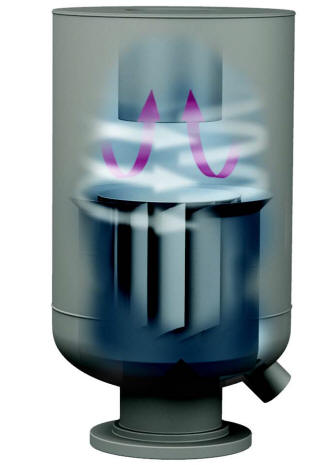
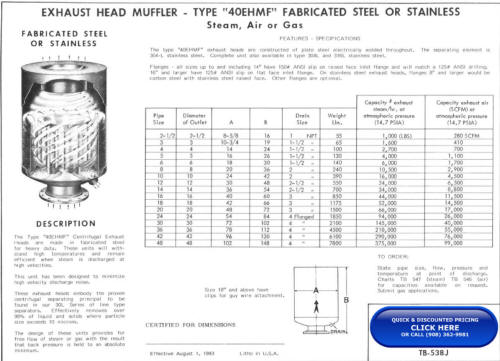
Custom fabricated exhaust heads are used when the required size, temperature, material compatibility or connection type exceeds the cast iron range. They are typically made from carbon steel (with 304 stainless steel internal vortex vane) or stainless steel.
A key advantage of fabricated units is that we can size the body for proper efficiency while providing a reduced inlet flange to match your existing pipe — eliminating the need for a costly adapter spool. We have fabricated exhaust heads for pipelines up to 42 inches.
How to Size an Exhaust Head
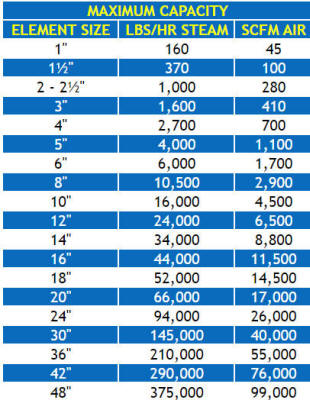
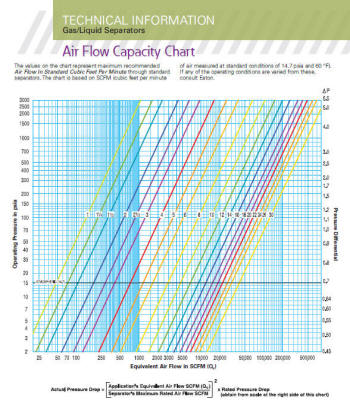
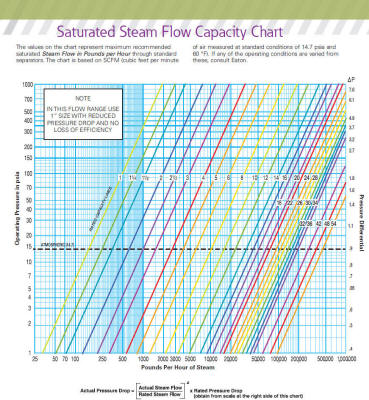
Always size an exhaust head at atmospheric pressure (14.7 PSIA). Because one end is fully open to atmosphere, flow rate determines the required size.
Refer to the capacity charts below or use the dotted line on the graphs. We can reduce the nozzle size of fabricated exhaust heads to match your pipeline without an adapter.
Contact us for alloy materials or temperatures over 650°F.
Fabricated Exhaust Head Outline Drawing